
Case studies
See how scientists have transformed their writing process, gained confidence, and published faster with the Zero-To-Published Program. These case studies share real experiences, showing how better scientific communication leads to greater impact.

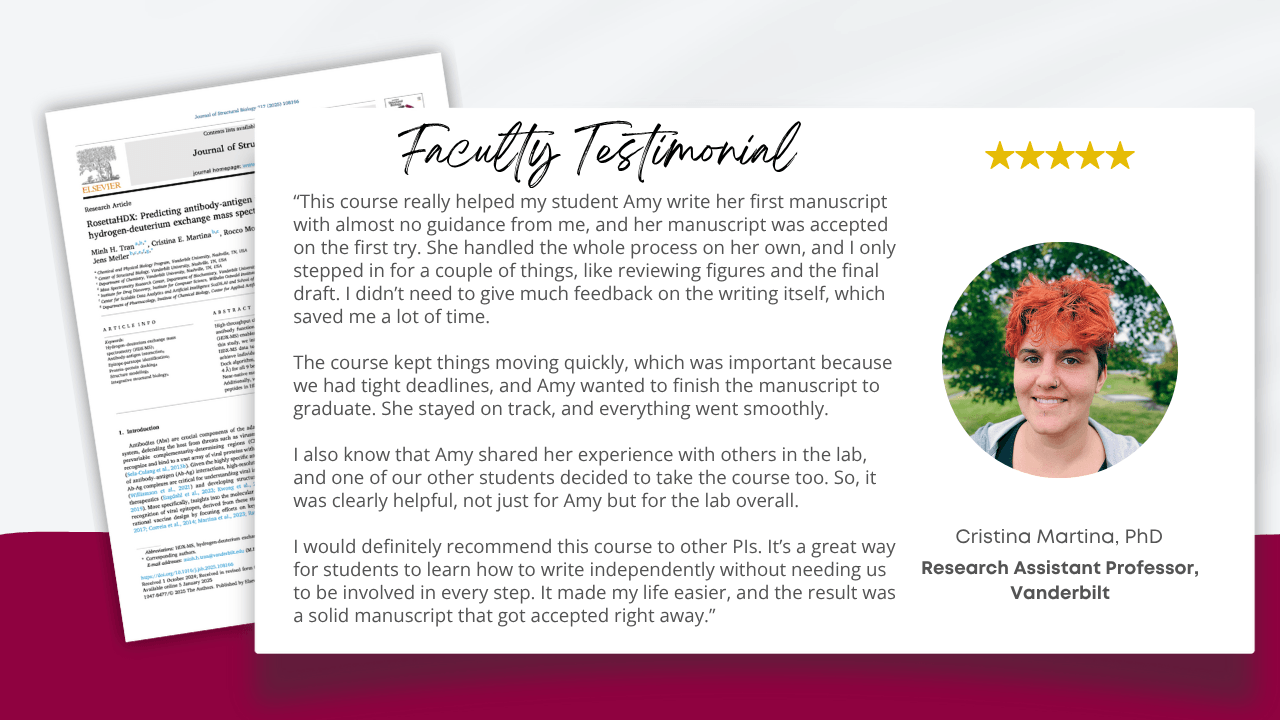
Can you briefly describe your trainee's writing abilities and independence before they enrolled in the course?
I don't know much because the other paper Amy wrote on HDX, I wasn’t an author on it, and I wasn’t mentoring her directly. This was the first time I saw her actually writing. Since I wasn’t Amy’s mentor from the beginning, I didn’t oversee earlier writing during committee meetings or other checkpoints. So, I can’t really give a before-and-after comparison.
What challenges or gaps in writing or scientific communication did you notice in Amy that prompted you to support her participation in the course?
I didn’t necessarily see any gaps in Amy’s skills. It just seemed like a good opportunity for her to get additional training.
Do you know whether she participated in any other writing or communication courses or trainings?
I’m not sure. I know the lab organized a one- or two-day seminar on writing—it could be grant writing or paper writing—but I don’t know if she attended those sessions.
Did you notice any changes in Amy’s ability to write or organize her manuscript as she progressed through the course?
It’s hard to recall specific details because this was some time ago, but I do remember there was improvement. At the beginning, some things were a bit sloppy, but after meetings with you, the final version was much better. I didn’t check every step—just the final version—but overall, it seemed to go very smoothly given the tight timeline and workload.
How much guidance did you give Amy throughout the course? How many interactions did you have, and what kind of feedback did you provide?
I didn’t give much direct guidance. She started the course and began writing independently. We had a couple of discussions about figures and their representation, but I didn’t need to oversee the writing itself. I remember advising her to send one final version rather than multiple “final” versions to the senior PIs to avoid wasting their time.
Did you review her outline or storyline?
I didn’t review the outline directly. Amy presented it during our monthly meeting. She organized it based on the figures and provided updates. I don’t recall us suggesting any major changes.
How independently did Amy work on her manuscript during the course? Did she frequently seek guidance?
I didn’t know her writing experience before the course, but during the course, she worked completely independently. My involvement was minimal, and another PI's contribution was also minimal. Her other PI may have been a bit more involved because he tends to be hands-on. After the reviewers' feedback came in, another co-author stepped in to provide guidance.
Were there any moments during the course when Amy came to you for additional feedback or clarification?
There was one instance where Amy wasn’t sure about how to handle conflicting feedback from multiple PIs, including me. We resolved it easily. I think this kind of confusion is natural when several PIs are involved.
Did you see improvements in how Amy approached developing her storyline and figures? How did the course influence these improvements?
Since I didn’t know her initial approach, I can’t say if there were improvements. However, she handled it very well, whether because of her own abilities or the course’s guidance. Overall, it was a positive experience.
How has Amy’s increased independence in writing benefited your lab or its overall productivity?
Her paper was accepted at the first try, which is a great outcome. My personal advantage was that I didn’t have to dedicate much time to the process. I checked the outline and figures but didn’t need to review much of the text until the final version.
What impact do you think the course has had on Amy’s confidence or ability to contribute to the lab’s research output?
It’s hard to say if it boosted her confidence. I hope it did, because she did a great job. She didn’t share much about how she felt, other than informing us that the manuscript was accepted.
Would you recommend this course to other PIs looking to improve their trainees' scientific writing skills?
Definitely. It’s especially useful for younger PhD students writing their first manuscript. As a PI, it’s beneficial not to have to deal with every intermediate step and instead focus on reviewing the final draft.
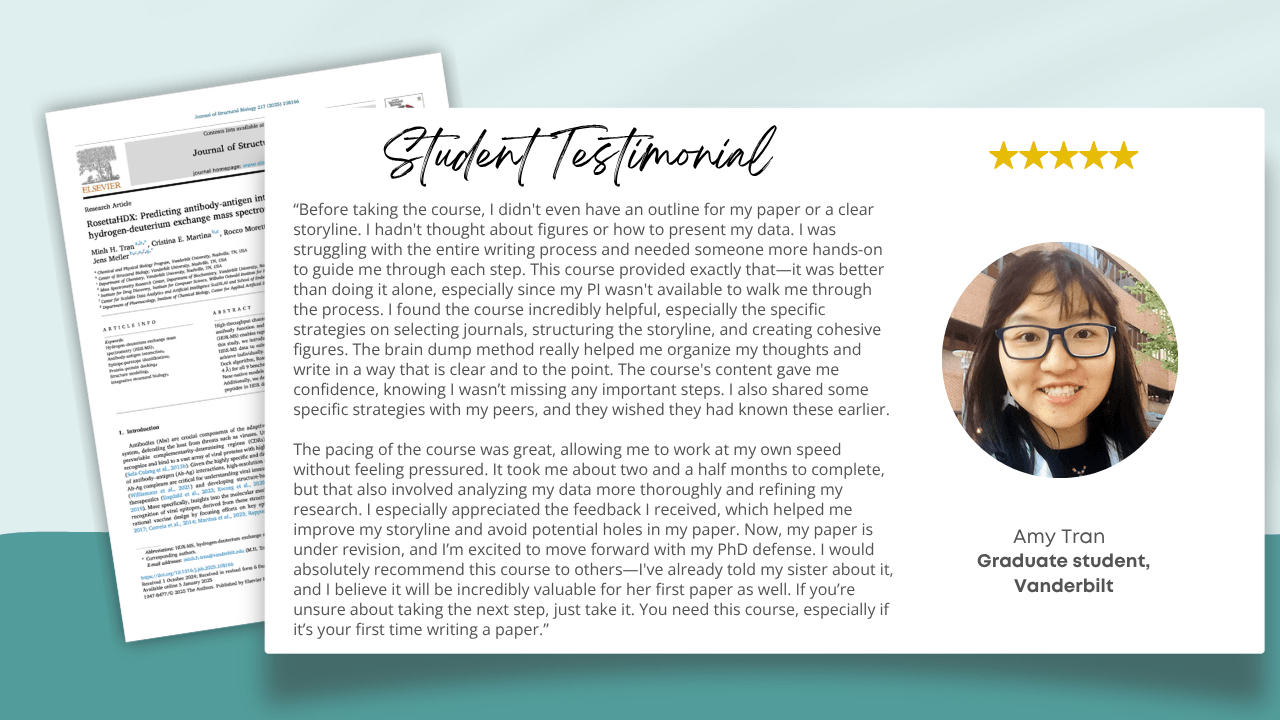
Can you briefly describe your situation before the course?
I would say I didn’t even have an outline for what I was going to write for a paper yet. I hadn’t really thought about the storyline or even making figures.
What were you struggling with at that time that made you want to go through the course?
I thought having the course and you as a more hands-on person to supervise and advise on my progress would be better than doing it alone. Even though my PI is very available, she still isn’t able to take me through each step. She’s available to read the draft, but I couldn’t get there without someone teaching how each step of the process goes. I benefited a lot from that in the course.
Have you tried other scientific writing courses? If yes, how is this one different?
I tried the Writing Center at my university, but it’s more like a writing accountability buddy program where you get together and just sit down and write. It’s not like a course, like what you did.
What were your thoughts going through the process? What were your doubts and fears about this? What made you say yes anyway?
Before I took the course, I had doubts because I thought this would just be another course that wouldn’t be very helpful. I thought it might be a waste of my time, going over what scientific writing is in general, which I didn’t need. But it turned out to be really helpful. I found so many useful things and learning really smart strategies. The brain-dump method and a lot of specific things that only someone who writes and submits so many papers could distill into this course were extremely helpful.
How would you describe the overall quality of the course?
Yeah, like 10 out of 10, really good!
How much time did you spend on the course and writing your paper? In weeks/months and also how much time did you spend daily/weekly?
I started around mid-July and finished by September 30, so about two and a half months of full-time work on it. But I realized I hadn’t thoroughly analyzed my results before starting. While writing the paper and making figures, I ended up asking a lot more questions like, "What if I look at the data this way?" or "What can I really say about this data?" I kept going back and doing small experiments, not big ones, but it wasn’t just the writing process. It was also distilling the research into a cohesive, logical storyline and making the figures.
How did you iterate on the storyline and figures? Did the videos and course make you think differently, or did feedback from your PI or me help? What specifically helped you iterate on these?
It came from multiple sources. Mostly, I remember a comment you made about choosing the distance restraint settings where we didn’t see significant improvement from any parameters, but we chose the most relaxed one to move forward with benchmarking. You asked, "Why?" That really got me thinking. I realized we chose it to prevent misleading effects from false negatives or positives. Those kinds of questions made me think more about the storyline and possible holes in the storyline. I added more details as a result. My PIs didn’t give much feedback during the early iterations, only after reading the draft. Another co-author gave good feedback towards the end.
How did you find the pacing of the course?
I think it’s good. Six weeks would be doable for someone working 100% on it and with the storyline already clear. I think most smaller labs would be able to finish in six weeks and still find the pacing really good. In my case, not many of my friends have the same situation with a busy PI like mine, so I think is a rare case.
Have you talked to your friends outside of your lab about this at all?
I did. One of my friends is jealous because she struggled a lot. She just graduated with her PhD, but she wished she had known the strategies I learned in your course about journals. She aimed high for a high-impact paper, and it took a month and a half to get rejected off the editor's desk. Then she had to reformat for a second journal, and after it was accepted for revision, it got rejected again. Now she’s on her third journal and has to reformat everything. She didn’t have someone to guide her through the process like I did.
How much of the videos did you watch? And how helpful were they?
I think I watched about 78%. They were very helpful, super helpful. I liked almost everything about them. They also gave me confidence, like a checkpoint to make sure I wasn’t missing anything before starting the introduction.
Would you say that attending this course was a productive use of your time?
Yes!
Would you recommend this course to a friend?
Yes, definitely. I already told my sister about it. She’s doing a PhD in neuroscience, and I think it would help her when she writes her first paper.
Which part of the course was most valuable to you?
The brain-dump method was really good because I thought I was someone who couldn’t get all my thoughts together, and it takes a lot of time to condense my writing. Understanding that this is a process people use and how to do it methodically was a highlight for me. Also, in the introduction, you talked about how to read other papers and condense them, then reorganize them into a clear introduction. I wish I had known that when I wrote my first review paper two years ago. My document was like a war zone back then.
Also, the cover letter section was really helpful. You dissected what a cover letter should include, gave examples, and explained which part answers which questions.
Which part was the least valuable to you? Why?
There wasn’t anything that wasn’t valuable. The only parts I didn’t use were the sections on other types of papers because I was writing a methods paper, but it’s not because they weren’t valuable—they just didn’t apply to my situation.
Was there anything that you found challenging or confusing? This also relates to expectations, what to work on when, etc.
I think the schedule was good. I liked how we scheduled things. Sometimes we met every week, and sometimes every two weeks, depending on my pace, which I felt good about. I didn’t feel pressured to meet every week, and I liked that.
Can you provide any other feedback or suggestions that could help improve future courses?
[long pause] Not that I can think of off the top of my head.
Where are you at now and how does that make you feel? What are you able to do now that you couldn’t before?
I feel better than when I was working on the paper, for sure. I’m excited because the paper is under revision now, and the last time I checked, two reviewers were already lined up and accepted to review it. This paper is really important because my committee already gave me the green light for defending my thesis, once my first paper is accepted. So I really look forward to getting this paper accepted so I can defend and wrap up my PhD.
What would you tell someone who is unsure about taking the next step?
Take it. Period. You need it, especially if this is your first paper.
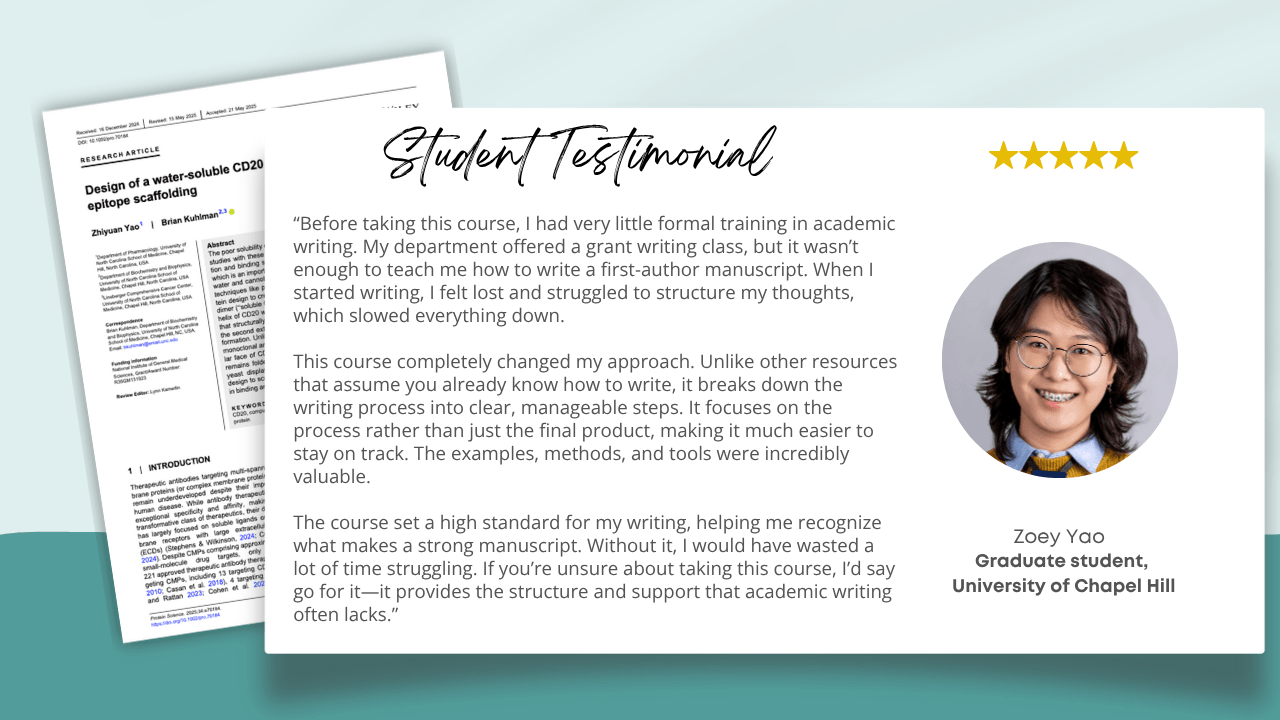
I want to know a little bit about where you were before you started. Can you describe your situation before the course? My situation before the course was that I had very little formal training in academic writing. In my department, we had a one-credit grant writing class, which included some general academic writing skills and peer feedback, but it wasn’t enough for writing a paper. A lot of time had passed since that class, and when I started writing my first-author manuscript, I didn’t know the steps to get there. That made the process really slow.
Do you remember some of the differences between that other class and this course? That class assumed students already knew academic writing. It focused on assignments—writing an introduction in one week, for example—but didn’t teach how to approach writing efficiently. Peer feedback was helpful, but this course actually taught me how to produce high-quality academic writing. It focused on the process rather than just the end product, making it completely different.
What were you struggling with at the time? I had a general idea of what I needed to write, but structuring my thoughts and maintaining logical flow was difficult. I got stuck on individual sentences, which slowed everything down.
Have you written papers before? I had written parts of papers, but not a full first-author manuscript.
What were your thoughts before starting the course? Any doubts or fears? I was struggling with writing, so I saw this course as a way to break down the process into manageable steps. My main expectation was structure and accountability to help me move forward.
Where were you in the writing process when you started? I had finished data collection and my first round of figures. Some data analysis was done, but I later revised parts of it.
How would you describe the overall quality of the course? I really liked it. It provided examples, methods, and tools I didn’t know about. When ChatGPT came out, the course immediately introduced how to use it for writing. It also covered data analysis and figure-making tools that aren’t usually taught in grad school.
What were your thoughts on using ChatGPT? Before the course, I used it mainly for language revision since English isn’t my first language. This course showed me how to use it to turn bullet points into a paragraph as a starting point. The output isn’t perfect—I still have to edit—but it saves time when I’m struggling with wording.
How much time did you spend on the course and writing your paper? We started in the summer of 2022, and I finished the final manuscript in December 2023. The course itself didn’t take much time—I watched each section as I worked on my manuscript.
How did you find the course structure and pacing? It was easy to find the sections I needed. The six-week structure is realistic if someone is fully dedicated to writing, but since I had other projects, I paced it differently.
How much of the videos did you watch? About 90%.
What impact did the course have on your writing? It set a high standard for writing. Before taking it, I didn’t understand the difference between a well-written manuscript and an average one. Now, I have a much better sense of quality. The course examples were really high-quality, which helped clarify what to aim for.
Would you say the course was a productive use of your time? Yes. Without it, I would have wasted a lot of time struggling with writing like I did before.
Would you recommend this course to a friend? Yes.
What was the most valuable part of the course for you? Breaking writing into smaller, manageable steps. The sections on introductions and conclusions were particularly helpful because they provided structured examples for different study types.
What was the least valuable part? I skipped about 10% of the course—sections that weren’t relevant to my research, like writing a review paper. But everything was clearly labeled, so it was easy to navigate.
What was the most challenging aspect of writing your manuscript? Finding large chunks of time to focus. It takes me time to get into the right mindset, and short writing sessions don’t work well for me. That’s not the course’s fault—it’s just how I work best.
What could help students struggling to find time for writing? Encouraging different working styles. Some people can write for one or two hours a day, but I need a dedicated writing week. Helping students experiment with different approaches could be useful.
Where are you at now? What happened with the paper? It’s out for revision, and we expect feedback next month. It’s a relief to have it submitted—it had been dragging out for so long.
Has this experience changed how you approach writing? Yes. Now, I schedule longer writing blocks instead of trying to write in short bursts. I also rely more on bullet points and use ChatGPT strategically to avoid getting stuck.
What would you tell someone unsure about taking this course? The most helpful part for me was breaking writing into clear, manageable chunks. There’s so much about academic writing that isn’t formally taught—this course provides that missing structure.
Have you seen anything like this course before? No. I looked for writing help, but writing centers mainly provide feedback on drafts, assuming you already have a written product. Books focus on final products rather than the process. This course is different—it helps you get from zero to one.
How involved was your PI in writing your manuscript? He was supportive but didn't help much with the early-stage writing. He’s an experienced writer but he doesn’t remember what it’s like to go from nothing to a full manuscript if you've never done it before. He gave feedback on my figures and edited my draft but didn’t help much in the early structuring phase.

